
If you own property in the UAE, a registered UAE will is what determines whether that property goes to the people you choose or gets distributed under default succession rules. Owning a title deed proves you own the property. It says nothing about who inherits it. That distinction matters more than most buyers realise, and it’s one every expat property owner in the UAE should understand before, not after, they need it.
At Sunrise Capital Dubai, we’ve been developing premium residential and commercial projects in Dubai since 2017, and a large share of our buyers are international investors and expat residents purchasing here for the long term. We’ve seen firsthand how many buyers focus entirely on the purchase and never think about what happens to the property afterwards. This guide covers what expats actually need to know about inheritance and property ownership laws in the UAE.
Freehold Ownership Gives You Title, Not a Succession Plan:
Dubai’s freehold system allows expats to hold full legal title to property in designated freehold zones, which is what makes areas like Dubai Marina, Business Bay, and Al Barsha accessible to foreign buyers in the first place. Holding that title deed is real, recognised ownership. It does not, on its own, determine what happens to the property when the owner dies.
What Happens Without a Registered Will:
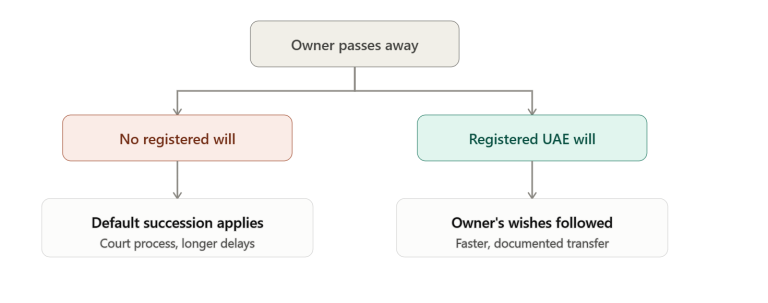
If an expat owner dies without a valid, registered UAE will, the estate is generally treated as intestate. Default succession provisions apply, and for many estates these draw on Sharia-based principles regardless of the owner’s nationality or personal beliefs. In practical terms, this can mean fixed shares allocated to specific family members, a court process that can take months, and property or bank accounts that remain frozen until that process concludes.
A common misconception is that jointly owned property automatically passes to the surviving spouse. The UAE does not apply the right of survivorship the way some Western legal systems do. If a couple jointly owns a property and one spouse dies, the deceased’s share enters the estate and becomes subject to the applicable succession rules, rather than transferring automatically.
Why a Foreign Will Isn't Enough:
Many expats assume a will drafted in their home country will govern their UAE property. In practice, enforcing a foreign will here usually requires legal translation, embassy attestation, and a formal court application, a process that can take considerable time with no guaranteed outcome. For real estate specifically, UAE law generally governs how property located in the country is disposed of by will, which is exactly why a locally registered will matters so much for property owners.
Testamentary Freedom for Non-Muslim Expats:
Since 2022, non-Muslim expats have had the right to register a will covering everything they own in the UAE, including real estate, giving them real control over how their estate is distributed instead of defaulting to statutory succession. Registration is the key word here. An unregistered will, no matter how carefully drafted, generally carries no legal standing in UAE courts. Non-Muslim owners can register through recognized channels, most commonly the DIFC Wills Service Centre or the Abu Dhabi Judicial Department.
Comparing the Two Paths:
| Without a registered UAE will | With a registered UAE will |
Who decides distribution | Default statutory/Sharia-based rules | The owner, per their documented wishes |
Typical timeline | Can extend to months via court process | Significantly faster, more predictable |
Property and accounts | Frozen until succession is resolved | Transfer process can proceed with clarity |
Spousal share of joint property | Not automatic; enters the estate | Can be clearly directed by the owner |
Guardianship of minor children | Determined by the court | Can be specified by the owner |
A Detail Most Owners Miss: Off-Plan Property:
Property purchased pre-handover still forms part of an owner’s estate, will or no will. Without a registered will, family members generally cannot complete registration or handover on an off-plan unit until the court appoints an estate representative, which can pause payment schedules and developer communications during that period. This is worth knowing if you’re investing in a project still under construction, since the paperwork gap can be longer than for a completed, titled property.
Structuring Ownership for More Complex Portfolios:
Some owners hold UAE real estate through a locally registered company rather than in their own name. This shifts the inheritance question from who inherits the property to who inherits the company shares, which can offer more flexibility for owners with multiple properties or more complex estates. It requires proper legal structuring, and it’s not a substitute for a will, but it’s worth discussing with a legal advisor if your UAE portfolio is growing.
Recent Reform: The Heirless Assets Rule:
A Civil Transactions Law update effective January 2026 addressed a long-standing gap for expats who die without a will and without identifiable heirs. Under the new rule, such UAE-based assets are designated as a charitable endowment rather than remaining in prolonged legal limbo. It’s a welcome clarification, but it underscores the same point every property owner should take from this guide: without your own documented instructions, the outcome for your estate is determined by default rules, not by your intentions.
Sunrise Capital Dubai's View on Ownership That Lasts:

We build with a long view. Projects like Legend, Legacy, 4/Solis, and Bellavion are designed as homes and investments people hold onto for years, often to pass on. As an award-winning developer with an end-to-end approach to property delivery, we believe part of serving our buyers properly is making sure they understand not just what they’re purchasing, but how to protect it for the people they care about.
A Note on This Guide:
This article is general information for expat property owners in the UAE and is not legal advice. Inheritance outcomes depend on individual circumstances, including nationality, religion, marital status, and how a property is held. Always consult a licensed UAE legal professional before making estate planning decisions.
Talk to Sunrise Capital Dubai:
Frequently Asked Questions
You don’t need a will to hold property, but without a registered one, your UAE property may be distributed under default succession rules rather than your own wishes.
Not automatically. Enforcing it in the UAE typically requires translation, attestation, and a court application, and UAE law generally governs how local real estate is disposed of by will.
The UAE doesn’t apply automatic right of survivorship. The deceased’s share enters the estate process rather than transferring directly to the surviving spouse.
Common options are the DIFC Wills Service Centre and the Abu Dhabi Judicial Department, both of which are enforceable by UAE courts.
No. The UAE doesn’t impose inheritance tax, though proper documentation is still essential for a smooth, timely transfer.